

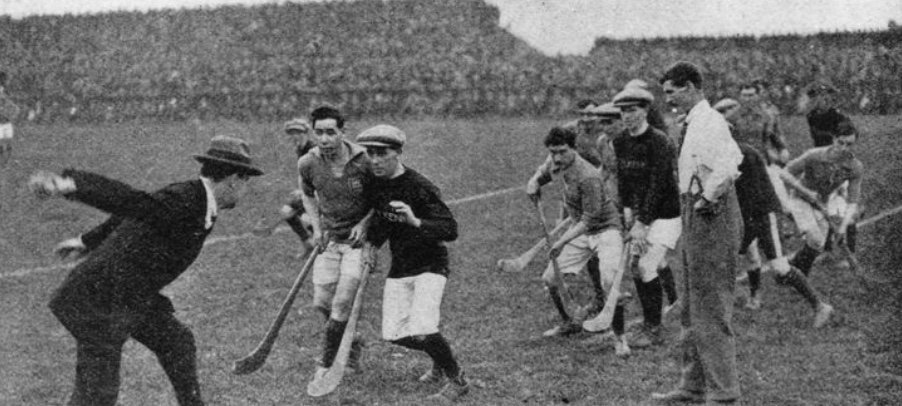
Ancient Sports
Gaelic football, hurling, and camogie are more than just sports—they are an essential part of Ireland’s cultural heritage. Passed down through generations, they connect communities, celebrate skill and athleticism, and embody Irish identity.
Hurling and Camogie
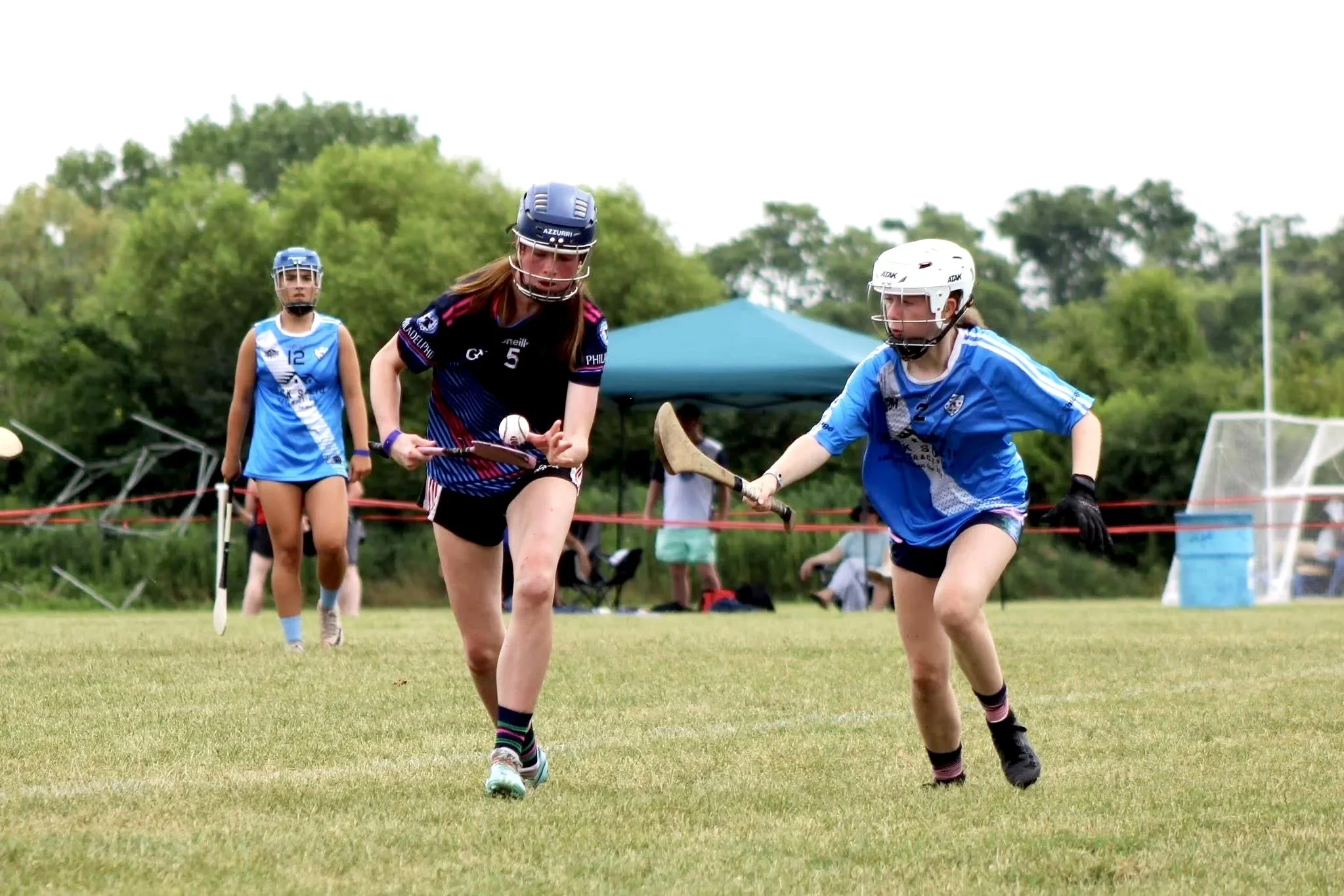
Hurling is the traditional field sport played by men and boys, while Camogie (pronounced ka-mo-gee) is the female version of the game. The two sports are very similar, with only a few rule variations.
Objective of the Game
Players use a wooden stick called a hurley (or camán in Irish) to strike a small leather ball known as a sliotar.
A team scores by hitting the sliotar between the opponent’s goalposts:
Over the crossbar and between the uprights = 1 point
Under the crossbar into the net (past the goalkeeper) = 1 goal (3 points)
Moving the Ball
Players may:
Catch the sliotar and carry it for up to four steps
Strike the sliotar in the air or on the ground with the hurley
Kick the ball
Strike it with an open hand (a hand pass) for short passes
If a player wants to carry the sliotar for more than four steps, they must:
Bounce it on the hurley, or
Balance it on the end of the hurley (known as “soloing”)
The sliotar may only be caught and held twice while in a player’s possession.
Hurling and Camogie are among Ireland’s oldest and fastest field sports, known for their speed, skill, and physical intensity.

Gaelic Football
Gaelic football is a traditional Irish sport governed by the Gaelic Athletic Association (GAA). It combines elements of soccer and rugby, with fast-paced play and unique ball-handling skills.
Objective of the Game
The aim is to score by sending the ball into the opposing team’s goal or over the crossbar:
Goal (3 points): Scored by kicking or punching the ball into the net.
Point (1 point): Scored by kicking or punching the ball between the upright posts and over the crossbar.
2 points are awarded when the scoring kick is taken from outside the 40- meter arc (a new line marked on the pitch) and then travels over the crossbar between the posts. (Boys ages 15 and up)
Moving the Ball
Players advance a spherical leather football up the field using a variety of techniques, including:
Carrying the ball (up to four steps at a time)
Bouncing the ball
Kicking
Hand-passing (striking the ball with the hand)
Soloing – dropping the ball onto the foot and kicking it back up into the hands
Gaelic football is known for its athleticism, skill, and high-scoring, exciting matches.